I approach this task with great humility. We have come today to this House of God, people of different faiths, myself as a Christian, to remember in our hearts - for that is where his memory truly lies - a faithful follower of Islam, a man amongst men and a King amongst Kings.
I approach this task with great humility. We have come today to this House of God, people of different faiths, myself as a Christian, to remember in our hearts - for that is where his memory truly lies - a faithful follower of Islam, a man amongst men and a King amongst Kings.
We have come here, above all, to remember a noble spirit and a true and honoured friend of Britain.
When Queen Noor asked me to give this address, I felt profoundly unequal to the task of doing justice to the memory of a truly inspiring individual whose personal kindness to me - and to many others with whom he came into contact - meant more than you can possibly imagine.
His overflowing humanity was legendary and, as Shakespeare put it in Henry VI, part II, in his face I saw 'the map of honour, truth and loyalty'.
It was his appetite for life which made him such a wonderful person to spend time with, 'laughing all the way', as one friend put it. And he had so many friends in Britain from the early days when he was at Harrow and, later, at Sandhurst - many of whom are here today, brought together by their affection and respect for him.
The King's time at Sandhurst, although only short, has almost become a legend in the annals of the Academy, partly due to the fact, I suspect, that the Academy Sergeant Major used to refer, famously, to him as 'Mr. King Hussein, Sir!'.
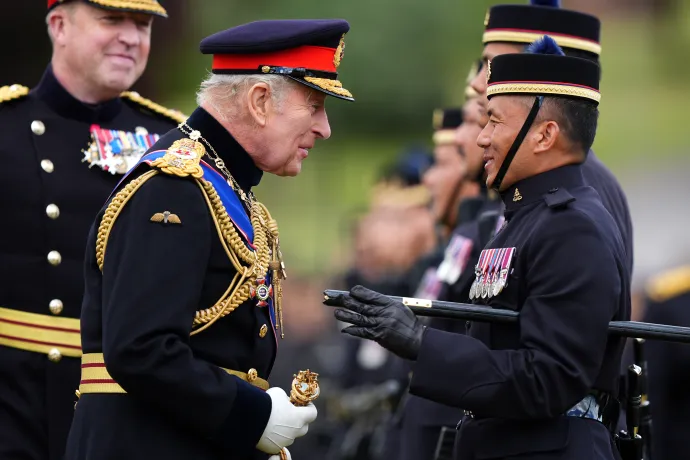
He considered Sandhurst as his second home, and it is therefore most appropriate that the cadet friends of Crown Prince Hamza are lining the steps today.
A respect for his fellow human beings gave His Majesty himself his extraordinary dignity. Many of us remember his immaculate manners and exceptional modesty; the way he would call his host 'Sir', regardless of rank - hugely disconcerting for some young British officer trying his best to get the protocol right!
In his public life his instinctive magnanimity helped him through some difficult times, permitting lasting reconciliations with those who had opposed him, sometimes with great energy or, indeed, malice.
None of these qualities was superficial. The way he dealt with the world seemed a natural consequence of his culture and education - a wonderful combination of the virtues of the Bedouin Arab and, if I may say so, the English Gentleman.
There is a story from Amman, of which Queen Noor and His Majesty's family may be aware, that it was the King's custom each morning to drink a glass of still water before leaving home for a day of public engagements.
One morning a new Bedouin servant brought him a glass of fizzy water, which he sipped and at once put down. The Bedouin whispered - 'Sir, if you don't finish that, Your Majesty's Major Domo, who is watching, will see and I shall be sacked.' Without a word the King drained the glass.
It was surely the King's magnanimity and far-sightedness, together with his other personal qualities, that enabled him to survive - and triumph over - the enormous challenges to his country and to himself.
It was his sheer courage in the face of a multitude of threats and difficulties in a volatile region that endeared His Majesty to his huge army of admirers in this country. It also endeared him to the Jordanian Armed Forces who responded with undying devotion and affection for their King.
It was his belief that his country was like his family that endeared him to his people and that has also helped to make Jordan an oasis of moderation, order and harmony in a harsh desert of extremes.
In an age of secularism and cynicism it seems to me essential that all men of faith - those who acknowledge the existence of a higher dimension beyond the narrow, destructive confines of the egocentric world view - should come together in recognition of a common understanding of what is sacred and enduring in the human experience.
As it says in the Koran, 'whoever believeth in God and the Last Day and doeth right - surely their reward is with their Lord, and there shall no fear come upon them, neither shall they grieve'.
King Hussein was a man of Faith who recognised in his turn the faith of others in a life beyond the illusory nature of this physical existence.
As a man who had the lively hope which also unites our two faiths, a lively hope in the reality of the life to come, he would have understood what Saint Paul says, that "though our outward man perish, yet the inward man is renewed day by day"'.
How wonderful it would be if our great sense of loss for a man of such tolerance and understanding could serve to remind us all that prior to modern times, despite many cases of strife among followers of various religions, there were also many instances of remarkable accord and harmony as each religious community realised in its heart the religious nature of the life of the other.
It is sometimes difficult for us to appreciate this in an age when secularism has, on the one hand, weakened religions and, on the other, hardened them in the face of external threat, and turned many of their followers away from the inner and spiritual dimensions of their own religions - where alone real peace and accord reside.
In this modern era, it is important for us in the West to be reminded of such notable instances of peace and harmony as occured, for example, in the case of Spain before the Reconquista where, during almost eight centuries, Christians, Jews and Muslims lived in remarkable peace - for this is what we must all have the vision, understanding and tolerance to strive for.
King Hussein was just such a visionary; his Jordan is a country rich in the venerated sites of other religions. Christ preached in this ancient land.
It is a Muslim state in which Christians are safe, respected and valued. In Jordan, Muslims and Christians respect each other's holy places and take part in each other's festivals, the Eid al Fitr and Christmas.
We forget too easily that the veneration of the Virgin is shared in the Middle East to this day by Christians and Muslims alike; that the mysterious prophet of the Muslims, Al Khidir, was identified with the Jewish Elias and the Christian St George; and that Mount Sinai remains sacred to Judaism, Christianity and Islam.
What better expression of harmony and understanding can be found, as I know from my own experience, than in the Monastery of Saint Catherine, a mosque built into its walls, in a place where Moses met God?
King Hussein had the kind of enlightened spirit which was in harmony with those who, in earlier periods of history, were able instinctively to respect the followers of other faiths for their piety and moral character, even if they did not accept them theologically.
I feel sure in my heart that His Late Majesty would want us to recognise, and emulate, the fact that in former times this tolerance and respect often transcended tribal, linguistic and ethnic factors; factors which have become the hallmark of modern nationalism in whose name we repeatedly witness appalling acts of brutality - mass murder, genocide and ethnic cleansing.
There is no doubt in my mind that the personal example of outstanding men like King Hussein becomes more important and critical than ever in these circumstances.
In the Rubaiyat of Omar Khayyam, the poet exhorts us to:
'Think, in this battered caravanserei, Whose doorways are alternate night and day, How Sultan after Sultan with his pomp Abode his hour or two, and went his way.'
This is perhaps sound advice for all in public life. But it is good sometimes, too, think of those who by virtue of their personalities made a more lasting mark. King Hussein of Jordan, Sidi (as so many of us knew him) was one such.
It was my country's fortune and privilege to have had him as such a close friend, and I am proud and grateful to have known a man whose qualities always reminded me of those words at the end of Shakespeare's Julius Caesar; "His life was gentle, and the elements So mixed in him that Nature might stand up And say to all the world, 'This was a man'."