But most of all I want to congratulate all of you who work on the front line in healthcare, for your dedication to transform hospitals and clinics into healing environments.
Minister, ladies and gentlemen, I am delighted to be contributing to today's conference - one that brings together two particular concerns of mine: human health, and the built environment. It is fitting, I think, that this conference on celebrating achievement has been arranged by two organizations of which I happen to be President: The King's Fund and my own Foundation for the Built Environment. The fact that they have come together to celebrate their individual and collective work with the National Health Service in improving the quality of the healing environment gives me enormous pleasure as, believe it or not, I have also served as Design Champion for the National Health Service since 2003 – something of which the vast majority of people in this Country are blissfully unaware!
It seems that we have made a bit of progress since that time, together with partners such as the Commission on Architecture and the Built Environment. Most N.H.S. trusts have appointed their own design champions, and a process for design review has been instituted at all levels of the N.H.S. The King's Fund is today celebrating a milestone in its “Enhancing the Healing Environment” Programme, and at the same time the Prince's Foundation for the Built Environment marks the completion of three Enquiries by Design to integrate new hospitals within sustainable communities.
In noting these accomplishments, I thought it might just be useful to talk for a moment about why I feel the whole question of health and the built environment is so vital.
I do believe that our modern, over-industrialized world is gradually coming to a new understanding of the extent to which all aspects of life are inter-connected. This recognition is slowly transforming our approach to medicine, to science, to our environment and to the way we build our world.
At the very core of a change in our philosophy, attitude and behaviour is, I would suggest, the notion of healing. Just as we now realize we can't treat organs in isolation, but must promote the health of the whole person, so we are beginning to see that we can't treat people in isolation from their environment either.
In building healing environments, one might begin the enquiry, as Keith Critchlow and Jon Allen did, at my request, in their seminal report for The King's Fund and the predecessor of The Prince's Foundation for the Built Environment in 1994, with the question “What is health?” They found that “health is the integral condition and experience of mind, body and spirit that exists when there is a dynamic balance between all aspects.”
We can therefore draw inspiration in the design of healing environments from all three sources.
Firstly, and most intriguingly, there is the human body itself. For it is precisely the proportions of the human body that have been held as the standard of wholeness and perfection, and that have served as a template for architectural discipline, in diverse societies and cultures, for literally millennia.
It is, of course, the human body too, that is precisely the crucial subject of our clinics and hospitals. To seek to recover this sense of scale and proportion, to re-instate this human scale of geometry to buildings to ensure that people's wellbeing is at the heart of the design process, is surely the first step toward creating healing environments that work for people.
Secondly, whilst the impact of the environment on our physical bodies is largely acknowledged, its impact upon the mind has been less easy to measure. But thanks to new technologies which monitor the brain's activities, this area is becoming better understood, justifying the belief which we have held for some time – that we care for our minds when we design easy-to-understand, well-structured places where we can comfortably find our way around.
As today's speaker Roger Ulrich has demonstrated, well-designed healing environments have been proved to reduce anxiety, lower blood pressure and reduce pain, and poor design has been found to contribute to negative effects including delirium, depression and, in some cases, longer hospital stays.
In the late 1960's, when the National Institute of Mental Health in the United States recognized the huge role played by the physical environment, it commissioned research that led to Professor Christopher Alexander's book “A Pattern Language”, which was one of the precursors of current urban codes. In that work, it was shown that each small pattern helps to build a nurturing environment, and that the combined effect of many of these patterns then leaves a person in a state where natural healing processes can flourish.
Fundamentally, health and healing come about when the accumulation of stress in the body's stress reservoir is kept within limits. When the stress reservoir is too full, as it is when a thousand small problems nag at a person's mind and body, the body's ability to respond well diminishes, and healing becomes difficult or impossible.
Thirdly, I would appeal for more care in how buildings are designed for sensory stimulation; how they can help - or indeed hinder - the human spirit.
One of the great problems with the tendency to see buildings as machines, let alone the people who inhabit them, is that it ignores the importance of the psyche in the healing process. How buildings are ventilated, illuminated, their relationship to Nature and landscape, the texture of materials and the careful use of colour are all crucial ingredients. So, too, is the absence of clutter and noise. We live in a noisy world, and yet silence, peace and stillness are often the keys to recovery, together with controlled exposure to fresh air – perhaps broken only by the sound of running water.
In the “Mozart effect”, studied experimentally over the last ten years, it appears that the presence of profound artistic unities paves the way for the free flow of intelligence and creativity, and also the healing of the physical body. The built environment has a similar capacity. If the fragile and subtle beauty of a room, ceiling, windows, light and sound in a room are in harmony, then people “flower” emotionally and spiritually. I'm sure many of you know what I'm thinking about when you think about it.
Research increasingly shows that design factors such as the presence of windows offering views and access to sunlight can lead to shorter hospital stays, perhaps because views of the natural world and, indeed, of buildings which fit sympathetically and sensitively into that world, lift the spirit.
We hear a great deal about “Seasonal Affective Disorder”, after all, and the effect of lack of exposure to sunlight that seems to be experienced by so many people.
Next, it seems to me, we need once again to take proper care of the external appearance of our buildings and their setting in the wider landscape or townscape. For many reasons, we seem to have almost entirely lost the ability to plan and design public buildings as key parts of the land and townscape around them. Historically, buildings like hospitals took their place in a hierarchy of building types, and stood as landmarks that provided a clear sense of order to residents and visitors alike.
Much of my Foundation for the Built Environment's work concerns designing ‘walkable' neighbourhoods by providing a layout of houses and amenities that allow people to source their daily needs on foot – preferably within a five-minute walk.
Research also suggests that walking or cycling for just half an hour a day can have a significant improvement on our state of health. But why don't we do it more? Often, as our speaker, Dr. Richard Jackson's, research suggests, because our towns and cities make it nearly impossible and because it might help a bit if the built environment was somewhat more attractive and appealing to the pedestrian.
Dr. Jackson and his colleagues have pointed to a disturbing link between the built environment, physical inactivity and what he terms a ‘syndemic' of diseases including, perhaps most worryingly, childhood obesity. We are grateful that he has taken the time to share his findings with us, as we are perhaps not far behind our American cousins in the “supersizing” epidemic!
One may think the kind of design aspiration that I have described is beyond reach in an era of tightening budgets. But my Foundation for the Built Environment's work with the former N.H.S. Estates has seen these principles brought to bear on practical projects through the unique “Enquiry by Design” public consultation programme. Whether designing an individual hospital or a whole town, Enquiry by Design brings all stakeholders together to reach consensus on a new design for their hospital and their community.
During the past two years, the Enquiry by Design process has helped shape new designs for three major hospital projects in Sunderland, London and Liverpool.
In Sunderland, the Enquiry by Design focused both upon integrating a mental health facility into a broader mixed-use development, but also on incorporating new models for care into the design of mental healthcare hospitals. The design that resulted will, we hope, now serve as the blueprint for a “joined-up” delivery by the local trust and English Partnerships.
In London and Liverpool, the Enquiries by Design were vehicles for addressing community concerns about the traffic and open space impacts of new hospitals. At the same time, the workshops have demonstrated that there is not an easy fit between local planning processes and health care procurement processes and that the integration of innovative design solutions into the P.F.I. process is far from perfect.
That is why it is so heartening to see a renewed call for design from within the National Health Service and from the wider community.
I know that all of you are working in your own way to address this challenge, and to ensure that hospitals and other health care facilities can become more attractive places in which to recover as well as work. The secret, I am sure, is to place the patient at the centre of the design process, not the technology – in the same way that more liveable communities can be created by putting the pedestrian at the centre of the design process and not the car.
Six years ago at The King's Fund's Open Day I pointed out that it could not be easy to be healed in a soulless concrete box with characterless windows, inhospitable corridors and purely functional wards. Clinical staff, especially nurses, were expressing real concern about the environment in which their patients were being treated. Something needed to be done about it.
Yet little did any of us imagine that within five years the resulting Enhancing the Healing Environment programme would have reached into more than 120 health organizations across the country. Today we celebrate that achievement and its continuing success.
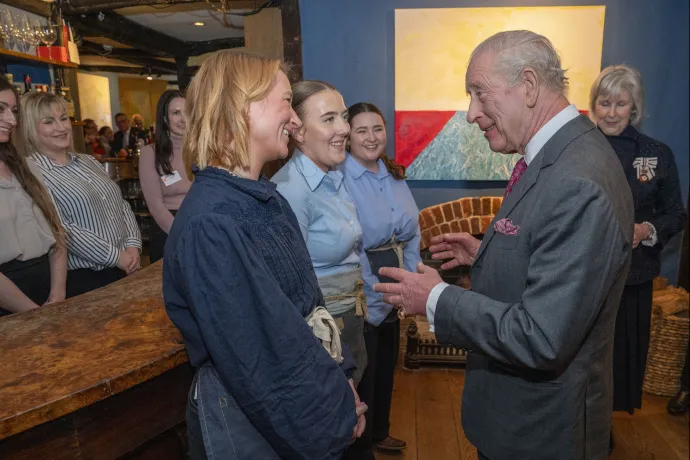
This is a programme that changes environments - but it also changes people, it changes attitudes to design and it changes institutions. As one team member put it, “we all tend to ignore the things we see every day, but just a little thought can make all the difference.” Another team member commented, and I quote, “in many instances, healing is not, in the main, about physical intervention – it is much more complicated than that. The environment in which we live and recover is critical. In this respect art and design have a crucial role”.
One director of nursing said that the programme had made a huge difference in the Accident and Emergency department - staff were now proud of their waiting room and, again, she too noted that the scheme had changed the way other projects were managed, designed and decorated throughout the hospital. “We've broken free of magnolia” she said. At another hospital, a ward sister commented that being involved in the project had been one of the best things she had done in her nursing career.
Today the Enhancing the Healing Environment programme enters a new phase with the launch of a set of pilot schemes that will focus on areas of care at the end of life.
There is a dearth of evidence in the U.K. about the impact of the environment both on those who are dying and on their family and friends - yet we know that that it is a critical factor in creating a peaceful and dignified end to life.
I am delighted that another of the charities of which I am Patron, Marie Curie Cancer Care, is joining this initiative. I would also like to thank all the other hospital charities who are joining the Fund in supporting this important work.
Ladies and gentlemen, too often, in the past, we have taken a step forward only to take two steps back. The widely-admired Peckham Centre flourished in London in the 1930's and 1940's, providing an environment in which pre-natal care, family counselling and post-natal care were combined with a swimming pool and dancing. This was a pioneering experiment in which social health, individual health and the physical environment were knit into an effective whole. It closed in 1950, never to re-open. The current ideas of what is “good design” have little to do with this dimension of experience and a considerable adjustment needs to be made, harking back to ancient prototypes – even though they may find expression in modern materials and modern techniques.
I would like to suggest this particular issue could be focussed, in the future, by an initiative to make the individual wards and hospital bed areas more profoundly healing. Perhaps prototype wards and rooms that represent the best thinking about the healing environment might be tried on an experimental and demonstration basis?
When all is said and done, it is worth noting that the consolidated effect of many minute aggravations on human stress was solved in principle by the patterns unearthed by N.I.M.H. research. That work was done forty years ago. Yet this cumulative impact of stress on human beings, and the possibility of solving it through careful use of the patterns which remove the stress points, has even now still not been adopted as part of mainstream practice by architects or planners, or by Government officials….
Finally, it is heartening that our efforts are now beginning to show results and I want to thank and commend both The King's Fund and The Prince's Foundation for the Built Environment for their good work, as well as the Department of Health and all the others who have helped fund the programme.
But most of all I want to congratulate all of you who work on the front line in healthcare, for your dedication to transform hospitals and clinics into healing environments.