A speech by HRH The Prince of Wales at the Royal Anthropological Institute's Centenary Dinner, London
Published
What a pleasure it is for a rapidly ageing graduate from the University of Cambridge to find himself in a position from which he can harangue a host of university professors and lecturers with apparent impunity? Even, dare I say it, my old social anthropology lecturer - Professor Leach.
His lectures were highly enjoyable - combining that ideal mixture of humour and information - although puzzling sometimes when investigating in detail the various relationships that exist with mothers-in-law and so on. If you can safely say that you enjoy a 'joking relationship' with your mother-in-law, then the world must be at your feet!
It has worried me considerably, since accepting the Patronage of this Institute in such tragic and shattering circumstances, that I have been unable to meet any of its members and perform my proper duties, but instead I have been observing many aspects of social anthropology in the raw in the Navy and have learnt a great deal about human behaviour as a result. I have also had time to think a little about the problems and challenges facing the RAI in the near future, as, I am sure, has almost everyone in this room tonight.
First of all, let me say that I agreed to become your Patron not only because of my past study of anthropology, but because I wanted to see the continuation of the Institute, the preservation of its superb library and the spread of the lessons to be learnt from even a polite knowledge of anthropology.
Of the continuation of the Institute I am certain. Of the preservation and rehousing of the library I have good reason to be hopeful, but the spread of popular appreciation of anthropology is a more complicated problem and one to which I have given a certain amount of thought.
The first thing to remember when searching for more funds is that the Institute is not a charitable body. It is not like an institute for immediately appealing things such as cancer relief and it is not well known. I doubt whether many people know what anthropology is by such things as the serialisation of The Naked Ape and The Human Zoo in the Sunday Mirror and several excellent travel films on the television. But, some might enquire, is it really necessary to make anthropology any more appealing and popular? And anyway, what good is it going to do?
The good it could do is to raise more essential money because, although it is earnestly hoped that the Government will assist in some way and Lord Eccles has given me cause for optimism, it is unlikely that much can be expected in the future owing to obvious and important priorities in Government spending. But it is essential to spread the basic knowledge of anthropology far wider for a whole multitude of reasons. Let me outline some of the ones I think are important.
Reason number one is that the more people can be assisted to appreciate and understand their own social behaviour, the more they can be assisted to develop a civilised, tolerant approach to human problems through greater self-analysis and the better and more healthy our society will be. We should all have a basic grasp of the elementary principle of evolution and our consequent close relationship with the rest of the animal kingdom; in some instances not close enough, for some animals seem manifestly more capable of conducting themselves sociably than many human beings.
We should have a shrewd idea as to why we react to various situations and stimuli in the way we do. It is vital to appreciate the intensely strong and irresistible demands imposed upon our sub-conscious by instinct, which so radically affects our behaviour patterns, and to understand the conflicting dictates of human rationality. By appreciating some of these things there is perhaps a chance that more people will begin to see world events and problems in a different way and to interpret history in the light of human behavioural problems.
I managed to locate my old examination papers from the archaeology and anthropology tripos at Cambridge in the Library at Windsor and looking through them for the first time I came across my supervision report in Social Anthropology - "He writes useful and thoughtful essays, although sometimes they are a little rushed. He is interested in discussion - likes to draw parallels between the peoples we study and ourselves." What a shrewd supervisor I had! But I think it helps to illustrate the useful application of anthropology to modern existence.
Reason number two is that an acquaintance with anthropology can enable those who never have a chance to leave this island, see other countries and witness the lives of their inhabitants, to understand something of the problems and difficulties experienced by immigrant communities in Great Britain. The more it is possible for this sort of enlightenment to spread, the more likely are we to reach a level of civilised tolerance in a multi-racial society. It should also be an aim to see that potential immigrants receive advance warning of the anthropological situation in this country and of what to expect, when they arrive in a state of bewilderment and anticipation.
Reason number three is that it is essential that we should know something about social groupings and patterns of behaviour in underdeveloped, underprivileged parts of the world so that the right forms of aid and development can be applied to them. In other words, ensuring that aid is given at first, in tune with the traditional customs and patterns of subsistence of the people concerned, and that this is then followed by more advanced techniques of farming and husbandry.
Having outlined some of the reasons for expanding the study of anthropology, how do we achieve this? First of all, anthropology must be made to seem less obscure and specialised to the general public. Certainly the Royal Anthropological Institute is a profoundly erudite body, but such topics as those which appear in 'Man', the journal of the Institute, are not calculated to cause a rush to the bookstalls, or the classrooms for that matter. In September's issue there were articles under splendid titles such as 'Tribalism and the polyethnic rural community' or 'An evolutionary interpretation of congenital frontal sinus absence in the Wadi Halfa mesolithic population'. And then there was an article which could easily cause a flutter in the hearts of any true born liberationist - 'Sexual insult and female militancy'. Only the last is likely to inspire any interest outside the fellows of this august body? probably amongst the police.
Secondly, with so many of you resident in or involved with both Oxford and Cambridge you should attempt to encourage the inclusion of anthropology in the 'O' and 'A' level syllabus and thereby reach a future important group of people while they are still with reasonably open minds at school.
Thirdly, more can probably be achieved by well-made films than by almost anything else and attempts will and are being made to pursue this important aspect of public relations. I am sure that the representatives of television here tonight will appreciate the problem and may be able to help."
Related content
Remarks by The King at 'A King's Trust Celebration' at the Royal Albert Hall
You'll all make a huge difference to this country and many others.

A speech by His Majesty The King at the White House State Dinner, Washington
Tonight, we are here to renew an indispensable alliance which has long been a cornerstone of prosperity and security for both British and American citizens. Our people have...

The King's Commonwealth Day Message 2026
Working together, we can ensure that the Commonwealth continues to stand as a force for good – grounded in community, committed to the kind of restorative sustainability that...
A message from The King on the death of Reverend Jesse Jackson
My wife and I were deeply saddened to hear of the death of the Reverend Jesse Jackson. We send our deepest sympathy to his family. I remember with great fondness meeting him...
A message from The King ahead of a reception at Windsor Castle to celebrate carers
So to those who provide care - whether you wear a uniform or simply the clothes you felt able to pull on in the morning - please know that the great love you show in small...
A message from The King, following the attack at Tumbler Ridge Secondary School in British Columbia
My wife and I were profoundly shocked and saddened to learn of the most dreadful attack at Tumbler Ridge Secondary School in British Columbia. We can only express our deepest...
Announcement of a State Visit by the President of the Federal Republic of Nigeria
A speech by His Majesty The King at the Lord High Admiral’s Divisions Parade, Britannia Royal Naval College, Dartmouth
My own service taught me that leadership is not about rank; it is, and has always been, about character. It is about making sound decisions under pressure, holding firm to our...

A message from The King in support of Stand Up To Cancer
Throughout my own cancer journey, I have been profoundly moved by what I can only call the 'community of care' that surrounds every cancer patient - the specialists, the...
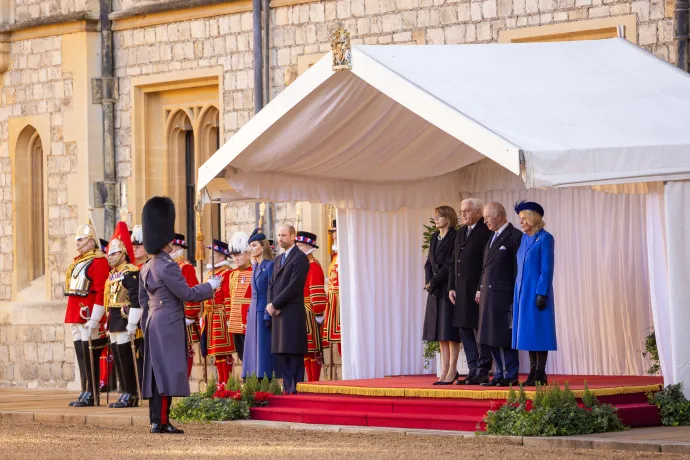
State Visit by The President of The Federal Republic of Germany and Ms. Büdenbender
03 December 2025
A message from The King to the people of South and Southeast Asia following devastating floods across the region.
My wife and I are deeply saddened to learn of the devastation caused by the terrible storms across South and Southeast Asia. We can only begin to imagine the scale of...
A message from The King to the people of Hong Kong following the devastating fire in Tai Po.
My wife and I were greatly saddened to learn of the devastating fire in Tai Po and feel deeply for the people of Hong Kong at such a tragic time. Our most heartfelt thoughts...

A message of condolence from His Majesty The King following the passing of Manfred Goldberg, Holocaust survivor and educator.
My wife and I were most deeply saddened to hear the news of Manfred Goldberg’s recent death and, together with everyone present, mourn his great loss in our hearts and souls...
A message from The King to the people of Jamaica and all those across the Caribbean affected by Hurricane Melissa
My wife and I have been deeply concerned and profoundly saddened to see the catastrophic damage caused by the ferocity of Hurricane Melissa in Jamaica and across the Caribbean...