A speech by The Prince of Wales at the Financing the Transition to a Sustainable 'Blue Economy' conference, St James' Palace State Apartments, London
Published
We need to mobilize resources in an intelligent way so that they create long-lasting and self-sustaining solutions.
Your Excellencies, Ministers, Ladies and Gentlemen, the only thing I can really do is bring people together, hence this gathering. If I may say so I am so delighted and grateful to you all for giving up your precious time to come here today to participate in a meeting that, I hope, will make at least a small contribution towards the future of our oceans, and help put us on a path towards a more intelligent use of the vitally important services they provide; services that in so many ways we totally rely upon for our continued prosperity, security and welfare.
As many of you probably know, my International Sustainability Unit began work on its Marine Programme in 2010 probably as a result of my agitating as to whether we could do more to bring people together in a partnership approach- private and public sectors. The International Sustainability Unit hasmade good progress and I am particularly heartened that there has been such willing engagement from so many different stakeholders. They all have to be part of the solutions for the sector that the world "appears" (I say tentatively!) to be striving towards.
Today's conversation is, I think, especially timely given the ongoing dialogue around the Sustainable Development Goals and the next phase of the Climate Change negotiations, both of which will be finalized next year. I do not need to tell you, I'm sure, how important it is that the future health of the oceans and fisheries is strongly reflected in these negotiations, such is its contribution towards global climate stability, food security, peoples' livelihoods and, critically, many countries' continued economic durability.
The challenges we face are immense and profoundly alarming. Just one example of this is the recent report from the I.U.C.N. stating that the Caribbean coral reefs could disappear altogether as a result of overfishing, pollution and development pressures. If this were to happen it would, of course be a total catastrophe. But this is by no means an isolated example of the threats to our oceans and the life they support. All around the world there are fisheries that are vastly depleted and either still declining or not yet recovering. At a time when the earth’s population, and therefore its appetite, is increasing rapidly this, if nothing else, seems a very short-sighted management practice of a valuable source of food.
Despite these rapidly accumulating and overwhelming challenges, it is at least of some encouragement that the state of the oceans has received such prominence of late with, among other things, The Economist's Oceans Summit in February, the Global Ocean Action Summit in The Hague in April, U.S. Secretary of State John Kerry's important meeting in Washington and the launch of the Global Ocean Commission's report on recommendations for action last month.
I would feel decidedly more encouraged, I must say, if I felt that such gatherings actually led to the kind of concerted, practical and innovative action that is so desperately needed, rather than just another round of discussions. This is why I am particularly pleased that today's meeting will add not only to the debate but also to the chances of a practical result by focusing on how to finance the transition to a more sustainable and economically rational state of affairs when it comes to our oceans. This is the real challenge, if I may say so, and yet, all too often, this critical piece of the puzzle is overlooked. We need to mobilize resources in an intelligent way so that they create long-lasting and self-sustaining solutions.
In the case of fisheries, we know from many examples around the world that the transition towards sustainability can deliver a wide range of economic, social and ecological benefits. The transition to sustainable fisheries, therefore, should be seen as a 'no regrets' investment. It requires capital today to ensure that these benefits exist tomorrow and, incidentally, that we prevent the worst kind of global conflict over scarce resources and the displacement of the poorest people from all those countless coastal communities around the world whose livelihoods and futures depend on genuinely sustainable fisheries in association with fully functioning marine ecosystems.
My I.S.U. has been working with the Environmental Defense Fund, the 50inl0 initiative, the Packard Foundation and the World Bank to further the understanding of how this might be done. They have come up with a framework that outlines the key components that will be required if financial capital is to be deployed to fund the right measures at the right time. This report has been made available today.
The report also demonstrates why attracting new sources of capital will require strong political will, leadership and commitment. This is vital to establish the conditions necessary to secure both the natural and social capital upon which the sustainable management of fisheries depends.
Perhaps this report's most important message is to show how financial capital and natural capital are so inextricably linked - with financial capital, of course, relying very much on natural capital. Economy and ecology do not have to be locked into an irreconcilable struggle. If we can structure investments based on this most fundamental of principles, then fisheries will not only be able to regenerate and ensure their resilience in the future, they will also be able to provide a real return on investment.
In closing, I would like to thank you once again for all the work you do in your different ways to enable progress to be made. Finding ways to manage the ocean's wild fisheries in a genuinely sustainable manner (which, currently, is not the case), is an enormous challenge. Overcoming the many difficulties will undoubtedly require a partnership approach with positive, integrated contributions from those in the public, private, and N.G.O. sectors and of course the active participation of local communities. But you don’t need me to tell you that the outcome is of huge importance to mankind and our future on this planet. Success would provide a much-needed example of how to regenerate our planet's dangerously depleted, threadbare and under-performing natural capital while also providing a realistic economic return.
Ladies and Gentlemen, your meeting could not be more important. I can only wish you every possible success and I greatly look forward to hearing about the positive outcomes.
Related content
Remarks by The King at 'A King's Trust Celebration' at the Royal Albert Hall
You'll all make a huge difference to this country and many others.
A speech by His Majesty The King at the White House State Dinner, Washington
Tonight, we are here to renew an indispensable alliance which has long been a cornerstone of prosperity and security for both British and American citizens. Our people have...
The King's Commonwealth Day Message 2026
Working together, we can ensure that the Commonwealth continues to stand as a force for good – grounded in community, committed to the kind of restorative sustainability that...

A message from The King on the death of Reverend Jesse Jackson
My wife and I were deeply saddened to hear of the death of the Reverend Jesse Jackson. We send our deepest sympathy to his family. I remember with great fondness meeting him...

A message from The King ahead of a reception at Windsor Castle to celebrate carers
So to those who provide care - whether you wear a uniform or simply the clothes you felt able to pull on in the morning - please know that the great love you show in small...
A message from The King, following the attack at Tumbler Ridge Secondary School in British Columbia
My wife and I were profoundly shocked and saddened to learn of the most dreadful attack at Tumbler Ridge Secondary School in British Columbia. We can only express our deepest...
Announcement of a State Visit by the President of the Federal Republic of Nigeria
A speech by His Majesty The King at the Lord High Admiral’s Divisions Parade, Britannia Royal Naval College, Dartmouth
My own service taught me that leadership is not about rank; it is, and has always been, about character. It is about making sound decisions under pressure, holding firm to our...
A message from The King in support of Stand Up To Cancer
Throughout my own cancer journey, I have been profoundly moved by what I can only call the 'community of care' that surrounds every cancer patient - the specialists, the...
State Visit by The President of The Federal Republic of Germany and Ms. Büdenbender
03 December 2025
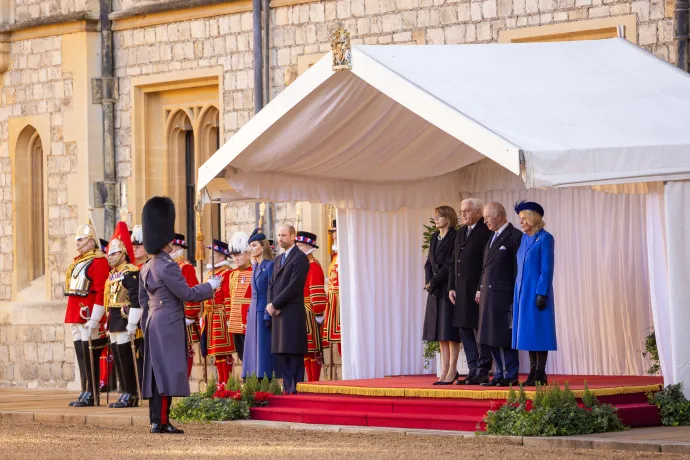
A message from The King to the people of South and Southeast Asia following devastating floods across the region.
My wife and I are deeply saddened to learn of the devastation caused by the terrible storms across South and Southeast Asia. We can only begin to imagine the scale of...
A message from The King to the people of Hong Kong following the devastating fire in Tai Po.
My wife and I were greatly saddened to learn of the devastating fire in Tai Po and feel deeply for the people of Hong Kong at such a tragic time. Our most heartfelt thoughts...

A message of condolence from His Majesty The King following the passing of Manfred Goldberg, Holocaust survivor and educator.
My wife and I were most deeply saddened to hear the news of Manfred Goldberg’s recent death and, together with everyone present, mourn his great loss in our hearts and souls...
A message from The King to the people of Jamaica and all those across the Caribbean affected by Hurricane Melissa
My wife and I have been deeply concerned and profoundly saddened to see the catastrophic damage caused by the ferocity of Hurricane Melissa in Jamaica and across the Caribbean...