A speech by The Prince of Wales at The Rare Breeds Survival Trust “Watchlist” 2013
Published
For forty years the R.B.S.T. has been building this country one of the most valuable insurance policies it has. I really am enormously proud to be its Patron, and not only that but to have witnessed the extraordinary effect it has had.
Ladies and gentlemen, speaking as an increasingly endangered species, I just wanted to say what an enormous pleasure it is for me to be with you in person for the presentation of The Marsh Awards and also to celebrate the fortieth anniversary of The Rare Breeds Survival Trust. It is a very significant occasion for the Trust and, can you believe it, I have been Patron for twenty seven years well over half its life and my admiration for the work of this remarkable organization and its countless volunteers is utterly boundless.
The facts of course speak for themselves, it was a fascinating presentation just now and I learnt a great deal from it. In the half century from 1923 until 1973 this country, as you all know, lost twenty-six breeds of livestock. Gone, forever. In the last four decades, since the founding of the R.B.S.T., not one breed of livestock has become extinct which I think is a remarkable testament to people’s efforts in these directions. It is also a great testament to the R.B.S.T.’s founding fathers, including Lawrence Alderson and Andrew Sheppey, who are both here today and, of course, to Joe Henson and how good it is to see his son, Adam, flying the flag for Rare Breeds on Countryfile every week. Incidentally we had him trying to lay one of my hedges at Highgrove last weekend at my annual friendly Hedgelaying Competition, and he did rather well. To them and all those who have worked so tirelessly since, we owe an enormous debt of gratitude.
Now, I know I am speaking to the converted here, but it is crucial, as is so often the challenge, that the wider population understands just why your work is so important. It isn’t some romantic attachment to a bygone era, or the fact that we think these native breeds look attractive in the field although obviously they do! The reason is that our ability to farm sustainably and on a continuing basis is dependent on their preservation and the characteristics contained in their genes.
I think it is quite instructive to remind ourselves why the breeds that are now on the endangered list find themselves there. Most have fallen victim to changes in agricultural practice. Subsidies, combined with cheap grain-based feedstuffs, meant that farmers moved away from cattle reared just on grass - and certainly hill cattle fell completely out of favour. Farmers invested in continental breeds that demand huge quantities of grain and protein-based feed to produce massive carcasses.
Anyway as you know, the dairy cow moved from one fed largely on grass to a very high yielding animal, but which depends on complicated and expensive dairy rations and has a relatively short life. Increasingly, this way of farming is, I believe, becoming unsustainable and that is why I became Patron of the Trust 27 years ago, because I just felt that the problem so often in life is that fashions change but there are of course timeless things and elements that matter crucially for our survival in the long term, and it seemed to me that it was insane to go on throwing an awful lot of babies out with the bathwater. That was another reason why I remember persuading the Duchy of Cornwall in the 1980s to buy the Brogdale Fruit Trials Centre, which was put up for sale by the then Ministry of Agriculture, MAFF. It seemed to me insane to lose that genetic pool of all our different fruit varieties. So at least we did manage to save that, and it is now in a trust.
With the evident effects of climate change, the growing demand for grain - and so its price - the forecast growth in the world’s population to nine billion, in itself entirely unsustainable I believe, and the desire for a more Western diet in China, the necessity to produce more food at home must surely increase. And when that happens, we will need to rediscover the genetic traits in our native breeds that meant they could flourish on our grassland, our uplands and even on some of the bleakest of Scottish islands as we’ve seen.
That is why I was so delighted to hear that the original native Aberdeen Angus, which certainly has the ability to get the most out of the roughest grazing, has recovered and moved the right way on the Watchlist. One of the problems I suspect for the native Angus was that its legs were too short, and suddenly everybody went berserk about Canadian ones with long legs. So at least they are going the right way now.
But how desperate to find the original Dairy Shorthorn, once the dominant cattle breed in the United Kingdom, in such dire straits... It is terrifying to think that there are now only 150 breeding cows remaining, and just how vulnerable these could be from disease.
That is why, back in 2001 after the horrors of Foot and Mouth which threatened to wipe out unique breeds of cattle, sheep, pigs and goats, I was so pleased that my Charitable Foundation was able to support the expansion of the R.B.S.T.’s gene bank. To remind you how serious it was, twenty per cent of the then five hundred remaining Whitefaced Woodland breeding ewes were destroyed and twelve per cent of the one thousand eight hundred Beef Shorthorn breeding cows were slaughtered. We live on a knife edge, and now with Schmallenberg and every other kind of horror, and TB in all directions, there is a real problem here.
If ever we needed a lesson in why it matters to ensure our rare breeds are widely distributed around the country, that was surely it. The threat from disease remains as real today, especially with TB, and so I do congratulate and thank those breeders around the country who farm the R.B.S.T.’s animals in the wonderful way that they do.
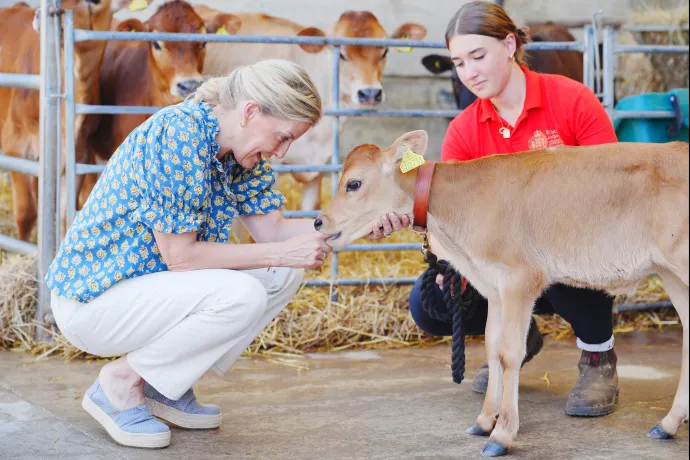
I am delighted that I am able to play a small part in all this with the farm at Dumfries House, in Ayrshire, which, thanks to Morrisons, is now home to five Whitebred Shorthorn heifers which the Trust purchased with a grant from my Foundation. There are fewer than 150 registered breeding cows remaining, and this embryonic herd will be bred pure, with semen from one of six remaining Whitebred Shorthorn bulls. And why does this breed matter? Its qualities are longevity, good temperament and good eating in other words, good for the environment, good for the farmer and good for the consumer.
Incidentally, the R.B.S.T. also used the grant to purchase a Vaynol heifer and she and her sister are being kept by a farmer in Scotland in the hope of creating the third herd of this breed, which is in the critical category of the Watchlist. Keeping all these animals in Scotland will hopefully provide some insurance against a disease outbreak. Meanwhile, I do my best on the farm at Highgrove where we have one or two Irish Moiled, which I think is still pretty critical, British White, which I hear now is becoming more threatened, Gloucester, Shetland cattle, along with Hebridean Sheep. Maybe even some Shropshire Sheep in due course as I have just discovered now, after being at Highgrove for 33 years and trying to establish wildflower meadows and orchards and things like that, that Shropshire Sheep are supposed to be tree-friendly. So I now plan to invest in one or two because when I graze the wildflower meadow, as there are trees in it, I have to put guards around the trees which is a major business. So having now finally discovered that Shropshire Sheep are tree-friendly, the chances are I will discover that they are tree-friendly everywhere else than when they come to me! Anyway I am so pleased to have found that Shropshire Sheep are doing better. So you can see that I have a veritable Old MacDonald’s Farm, trying to keep all sorts of other rare breeds, whether its fruit or vegetables or trees or chickens, going.
Of course, the Trust’s success in its great endeavours depends so much on remarkable individuals who work tirelessly to safeguard the incredibly precious resource which is held in the D.N.A. of these native and traditional breeds. Today we are celebrating three of them and I would particularly like to congratulate personally Mr Otter, Mr Freeman and Professor Woolliams. They understand the enormous importance of genetic diversity for the health of our farmed animals and for the future of genuinely sustainable farming. They also understand that grazing animals help to shape and maintain the great variety of the British countryside and, increasingly, we are rediscovering the ancient wisdom and learning that when livestock and landscape work in harmony some of our most important wildlife habitats, such as the Somerset Levels, can be enhanced and protected.
For forty years the R.B.S.T. has been building this country one of the most valuable insurance policies it has. I really am enormously proud to be its Patron, and not only that but to have witnessed the extraordinary effect it has had. You have shown foresight, wisdom and determination, often swimming against the tide of received wisdom. I have no doubt at all that your work will play a crucial role in our ability to produce high quality food in a truly sustainable way. Many, many congratulations to all of you, and keep breeding.
Related content
Remarks by The King at 'A King's Trust Celebration' at the Royal Albert Hall
You'll all make a huge difference to this country and many others.
A speech by His Majesty The King at the White House State Dinner, Washington
Tonight, we are here to renew an indispensable alliance which has long been a cornerstone of prosperity and security for both British and American citizens. Our people have...
The King’s Address to the Joint Meeting of Congress in Washington
The Alliance that our two Nations have built over the centuries – and for which we are profoundly grateful to the American people – is truly unique.
The King’s message to commemorate the 100th anniversary of the birth of Queen Elizabeth II
Queen Elizabeth’s ‘promise with destiny kept’ shaped the world around her and touched the lives of countless people across our nation, the Commonwealth and beyond.
The King's letter to Colonel Jeremy Hansen ahead of the launch of the Artemis II mission
It is with immense pride and a profound sense of shared purpose that I write to you as you prepare to embark upon the Artemis II mission.
The King and Queen will undertake a State Visit to the United States of America followed by a Royal Visit by The King to Bermuda
A Speech by The Queen at a Literary Reception to mark the fifth anniversary of Her Majesty's Reading Room
I find it hard to believe that it is five years since I founded it, at the height of lockdown, with the simple aim of sharing my lifelong conviction that books make life...
The King's speech at the Nigeria State Banquet
We in the United Kingdom are blessed that so many people of Nigerian heritage, having chosen Britain as their home, are now at the heart of British life through excelling at...
The Queen's speech at a WOW reception to mark International Women's Day
Every woman has a story. And these stories must be told. Because when we live in a culture of silence, we empower violence against women and girls.
The King's Commonwealth Day Message 2026
Working together, we can ensure that the Commonwealth continues to stand as a force for good – grounded in community, committed to the kind of restorative sustainability that...
Royal Household Gift Policy 2026
This Gift Policy seeks to provide a framework for the management of gifts by The Royal Household, on behalf of The Sovereign and other Members of The Royal Family.
A message from His Majesty The King congratulating Team GB and teams across the Commonwealth on their successes at the Winter Olympic Games in Milano Cortina.
As the Winter Games come to a close, my wife and I send our most heartfelt congratulations to all the Olympic medal winners from Team GB, Canada, Australia and New Zealand, on...
A message from The King on the death of Reverend Jesse Jackson
My wife and I were deeply saddened to hear of the death of the Reverend Jesse Jackson. We send our deepest sympathy to his family. I remember with great fondness meeting him...
The Queen hears about Avon and Somerset Police's approach to tackling domestic abuse
12 February 2026
A message from The King ahead of a reception at Windsor Castle to celebrate carers
So to those who provide care - whether you wear a uniform or simply the clothes you felt able to pull on in the morning - please know that the great love you show in small...
A message from The King, following the attack at Tumbler Ridge Secondary School in British Columbia
My wife and I were profoundly shocked and saddened to learn of the most dreadful attack at Tumbler Ridge Secondary School in British Columbia. We can only express our deepest...